
Process plants do not suffer from lack of data. They suffer from lack of shared visibility.
Modern process plants generate enormous quantities of information. Temperatures, pressures, flows, levels, compositions, alarms, laboratory data, and performance indicators are continuously measured, recorded, and reviewed. Yet in many industrial environments, despite this abundance of information, a clear and shared understanding of what is really happening inside the plant is still missing.
This is one of the fundamental limits of process industry. Information exists, but it is often fragmented across functions. Process engineering develops one type of understanding, operations another, maintenance another, and management often sees the plant only through dashboards, summaries, and KPIs. Each function works with useful information, but the plant is rarely seen as one connected and dynamic system.
The result is a familiar situation. Operators rely heavily on experience and on the signals immediately visible in the DCS. Engineers think in terms of balances, constraints, design intent, and plant behaviour over time. Management evaluates performance through production, cost, yield, and reliability indicators. All these views are valid, but they are not always integrated into a common operational picture.
When this happens, the plant remains only partially visible. Data is present, but understanding is incomplete. Knowledge exists, but it is not always transferred effectively. Performance gaps appear, yet the real mechanisms behind them are not always easy to see. Training becomes slower. Cross-functional discussion becomes harder. Troubleshooting becomes more dependent on individual experience. Continuous improvement loses clarity.
The Glass Plant starts from this problem.
Its purpose is not simply to display more information. Its purpose is to make plant behaviour more visible, more understandable, and more shareable across the organisation.
The core idea behind the Glass Plant
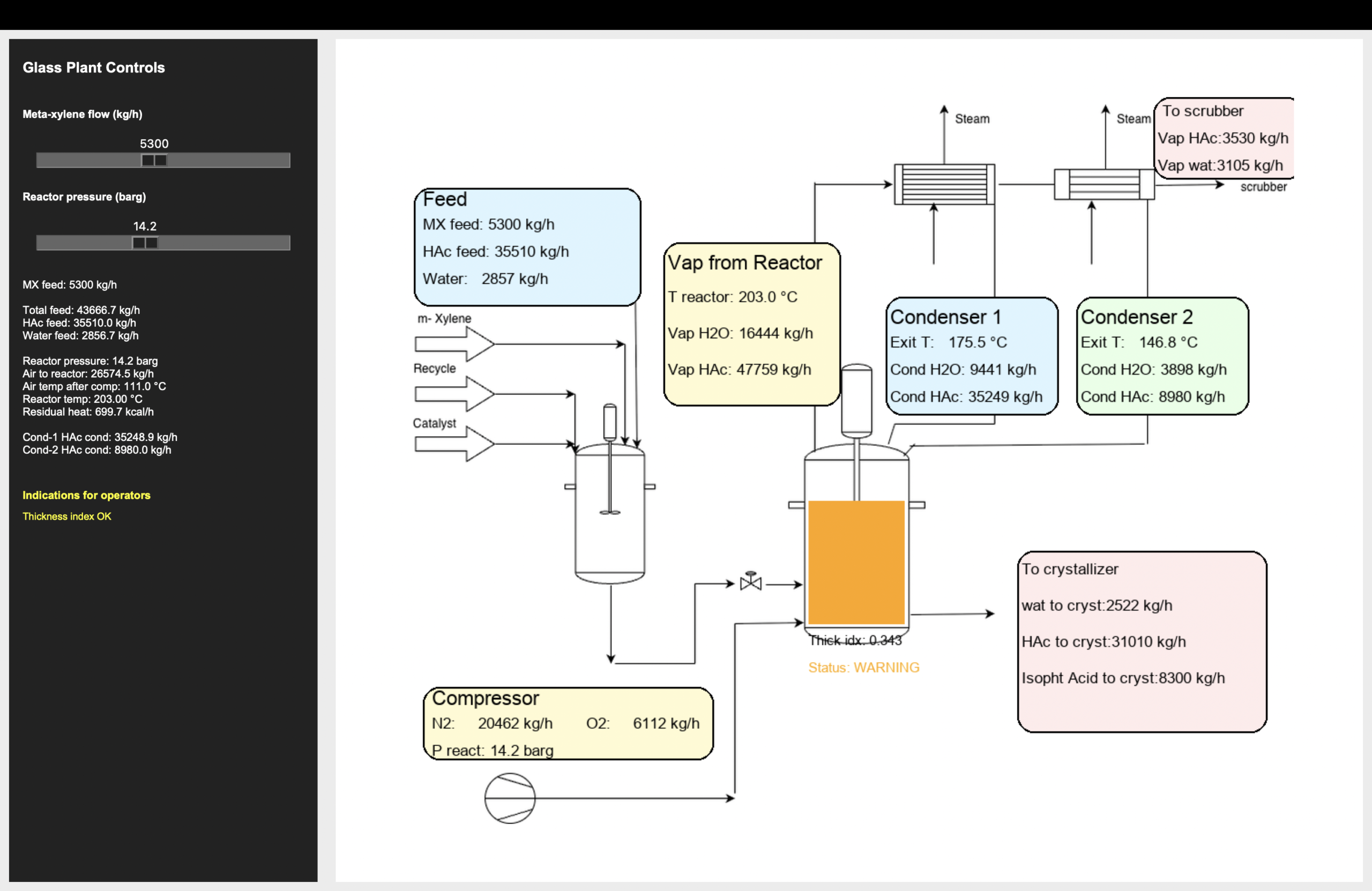
The basic idea behind the Glass Plant is to capture, in a Dynamic Visual Representation, the knowledge developed across the various functions involved over the plant’s lifetime.
Every plant contains layers of knowledge. There is the original design intent. There are process calculations, mass and energy balances, equipment constraints, operating limits, historical practices, operator experience, troubleshooting patterns, and performance targets. Over time, all of this knowledge accumulates, but it is rarely brought together in a form that is easy to read and easy to use.
The Glass Plant aims to create that form.
Starting from the original process design, the plant schematics are progressively enhanced to represent not only physical variables such as temperature, pressure, and flow, but also the composition and concentration of the different process streams. In this way, the knowledge generated during the design phase is preserved, made visible, and transferred more effectively into operations.
To support operator understanding, vessel contents and stream compositions are no longer shown only as numbers. They are transformed into coloured visual representations that reflect the actual concentration of the substances involved. This allows operators to “see” what is happening inside the steel walls of the plant, as if the equipment were made of glass — hence the name, The Glass Plant.
This point is central. In most plants, operators and engineers must imagine what is happening inside reactors, columns, vessels, pipelines, absorbers, evaporators, or tanks. The physical plant is closed steel. What is happening inside it is inferred from tags, instruments, trends, calculations, samples, and experience. The Glass Plant proposes a more intuitive layer: a dynamic representation that turns hidden process behaviour into something visually understandable.
It is not a replacement for engineering discipline, operating procedures, or DCS systems. It is an additional operational layer that makes the plant more readable.
From static schematics to dynamic understanding
Traditional plant schematics are essential, but they are static. They show the structure of the process, the main equipment, and the principal flows. They are extremely useful for design, documentation, and reference. But on their own, they do not show living process behaviour.
Similarly, DCS screens are essential, but they are often built around control functions, operating parameters, and alarm logic. They are highly valuable for plant control, but not always ideal for explaining the wider behaviour of the system in an intuitive and integrated way.
The Glass Plant sits between these worlds.
It starts from the technical rigour of process design and links it to a dynamic visual logic that can be understood operationally. It does not reduce the plant to a dashboard, nor does it leave knowledge buried in calculations, reports, or expert intuition. Instead, it progressively converts this knowledge into a visual process language.
In such a representation, physical variables remain important, but they are no longer isolated. Composition, concentration, expected behaviour, and process response become part of the same picture. The plant is no longer read only through individual tags. It is understood as a system.
This is where the real value begins to emerge.
The Dynamic Visual Simulation can be used in different ways depending on the application. It can be used offline for training, process understanding, and what-if analysis. It can be used online to support live plant monitoring and interpretation. It can also be used in a differential mode, in which real operating data are compared with the theoretical or expected plant behaviour. The gap between the two becomes a source of insight, helping identify deviations, losses, and optimisation opportunities.
The reference behaviour of the plant
The variables and representations shown in the dynamic view describe the theoretical or expected behaviour of the plant.
This expected behaviour is not an abstract academic model detached from operations. It is a reference condition derived from process understanding, design logic, known relationships, and the intended operating mode of the plant. It acts as a structured benchmark against which actual plant behaviour can be compared.
By comparing this reference condition with the real operating state, it becomes possible to identify deviations, highlight operational gaps, and understand where losses are being generated relative to the plant’s ideal performance.
In many industrial situations, losses are visible only indirectly. Yield decreases. Steam consumption rises. Cooling demand increases. Product quality drifts. Waste grows. Energy efficiency worsens. Alarms become more frequent. Production stability becomes more fragile. These effects are real, but the underlying process mechanisms are not always easy to visualise.
The Glass Plant aims to make those mechanisms more visible.
Instead of seeing only the final consequence, operators and technical teams can begin to see where the process is moving away from the expected condition. This changes the quality of the conversation. The plant is no longer judged only by output indicators. It can also be understood through the behaviour that generates those indicators.
This is especially important because losses do not appear only in obvious failures. Many losses are created gradually, through drift, suboptimal settings, unrecognised deviations, incomplete understanding, or local optimisation that is not aligned with system behaviour.
A clearer process representation helps expose those gaps earlier and more concretely.
From technical deviations to business value
One of the most important aspects of the Glass Plant is that it creates a bridge between technical behaviour and business performance.
When deviations from expected behaviour can be identified more clearly, the associated losses can also be better understood. Depending on the plant, these losses may appear in raw material efficiency, utility consumption, capacity reduction, off-spec production, waste generation, reliability impact, safety margin erosion, or excessive operator intervention.
These losses can then be quantified, monetised, and translated into KPIs aligned with management priorities.
This is a crucial connection. In many organisations, management works with economic and performance indicators, while operations and engineering work with process conditions and technical constraints. The two worlds are linked, but not always in a way that is visible day by day.
The Glass Plant helps strengthen that link.
It allows plant behaviour to be interpreted not only in technical terms, but also in terms of operational and economic consequence. In this way, KPIs are no longer seen only as management numbers placed above the plant. They can be connected back to the physical behaviour of the system itself.
This can improve the quality of decision-making. It can also make performance discussions more concrete, because the conversation is no longer limited to whether a KPI has moved. It can include why it has moved, where the gap is developing, and which part of the system is contributing to it.
Enhancing understanding across the whole company
A clearer and more intuitive visual representation improves understanding across all levels of the company.
This matters because plant performance is not created by one function alone. It depends on the interaction between operations, engineering, maintenance, laboratory support, technical leadership, and management. When these groups do not share a sufficiently coherent picture of plant behaviour, misunderstanding and inefficiency tend to increase.
The Glass Plant supports a more shared language.
Operators can see process behaviour more intuitively. Engineers can connect visual patterns to technical mechanisms. Managers can relate performance discussions to a more understandable plant picture. Technical meetings can become more focused because discussion is grounded in a common representation rather than in disconnected fragments of data.
This does not mean that every function needs the same level of detail. It means that each function benefits from a better shared basis.
Company-wide understanding improves when the plant becomes easier to read.
That improvement is not only useful in troubleshooting or optimisation projects. It also matters in daily operations. A plant that is better understood is easier to manage, easier to explain, and easier to improve.
Benefits for operators
For operators, the value is immediate.
A clearer representation helps them understand not only current readings, but also the meaning of those readings within the wider process. Instead of relying only on fixed DCS parameter settings to keep the plant stable and optimised, operators are better supported in understanding how the process is actually behaving.
This can strengthen process intuition.
Experienced operators often develop powerful internal models of the plant. They know how it reacts, where it drifts, which signals matter most, and what combinations of conditions require attention. That knowledge is extremely valuable, but it often remains partly implicit.
The Glass Plant supports this way of thinking by making process relationships more visible. It helps operators recognise drift earlier, see interactions more clearly, and maintain the plant closer to desired operating conditions.
It also helps reduce the gap between seeing a value and understanding its significance. A number on its own may be correct, but its operational meaning may not always be obvious. A dynamic visual context can make that meaning more immediate.
This is particularly useful in complex plants where effects are delayed, distributed, or non-obvious. In such situations, a more visual and integrated representation can improve judgement and response quality.
Benefits for engineers and technical teams
For engineers and technical specialists, the Glass Plant offers a different but equally important value.
Engineering understanding often exists in the form of calculations, simulations, reports, balances, performance reviews, and technical reasoning. This is rigorous and essential, but it is not always easy to transfer into daily operational language.
The Glass Plant helps create that bridge.
It provides a way to express process behaviour visually without abandoning technical depth. This can improve troubleshooting discussions, plant reviews, optimisation work, and communication with non-specialists. It can also help prevent situations in which technically valid insights remain underused simply because they are not communicated in a form that supports broad operational understanding.
A better shared representation also helps when discussing plant limitations, trade-offs, or the consequences of changing one variable on other parts of the process. Instead of explaining those interactions only verbally or through separate calculations, the technical team can use a common visual structure to support the reasoning.
This is not simplification in the negative sense. It is clarification.
Training new operators and accelerating learning
Training is one of the strongest applications of the Glass Plant.
The Dynamic Representation can be used for training new operators, making it easier for them to understand the internal behaviour of the production plant. The ability to visualise what happens inside the process through intuitive, coloured schematics makes learning faster, more natural, and more effective.
Traditional training relies heavily on static diagrams, procedures, operating limits, and explanation by senior personnel. All of this remains necessary. But in many plants, new operators initially learn what the equipment is called and what the numbers should be before they truly understand how the plant behaves as a living process.
The Glass Plant can accelerate the formation of that mental model.
Instead of relying only on fixed schematics and lists of numbers, the explanation can be anchored to a simulator-like environment that immediately clarifies correlations within the plant itself. Variables can be changed to show how the plant responds to operating variations, helping new operators develop practical understanding rather than memorising isolated data.
This is especially important in plants where the consequences of a change are not instantaneous or not local. One section may influence another through recirculation, accumulation, thermal effects, composition drift, or downstream disturbance. A dynamic representation makes these links easier to grasp.
The result is not only faster learning, but better learning.
Capturing and structuring expert knowledge
A major part of plant knowledge is never fully written down.
It lives in the experience of expert operators, senior engineers, technical leaders, and specialists who have spent years observing how the plant really behaves. They often know which deviations are early warning signs, which combinations of signals are meaningful, what hidden constraints matter most, and how operating judgement should be applied in situations that procedures do not fully describe.
This knowledge is essential, but it is also fragile.
When it remains only in the minds of individuals, it is difficult to transfer, difficult to scale, and difficult to preserve. Retirement, turnover, reorganisation, and role changes can all weaken the continuity of this knowledge.
The Glass Plant can help capture and structure that practical understanding to create a form of shared operational intelligence.
In this way, knowledge no longer remains only in the mind of the expert operator, but is connected to the physical reality of the plant and transformed into shared understanding. The value here is not only documentation. It is externalisation. It is the conversion of tacit operational knowledge into a form that can support others.
This does not reduce the importance of human expertise. On the contrary, it gives that expertise a stronger and more durable place inside the organisation.
Supporting safer operation
Safety is another important area where the Glass Plant can contribute.
With the Glass Plant approach, simple what-if analyses can be performed when changes are made to plant settings, especially when operating outside historical limits. This can help identify potential hazards in advance and highlight situations that are approaching the boundaries of the plant’s safe operating envelope.
In practice, many risks do not arise only from dramatic failures. They also emerge from gradual movement away from stable conditions, from incomplete understanding of interacting effects, or from operational decisions taken without a sufficiently clear view of system behaviour.
A more readable process representation can help make these situations more visible.
By linking changes in conditions to an understandable process picture, the Glass Plant supports more informed judgement before the plant moves too close to unsafe or unstable zones. It can also improve the quality of discussion around non-routine operation, process changes, upset response, and evaluation of margins.
The safety contribution is therefore not only reactive. It is preventive.
Alarm understanding and operational context
Alarm management is often a challenge in process plants.
Over time, alarm systems tend to accumulate large numbers of signals. In upset conditions or in the event of device malfunction, operators can be flooded by alarms appearing in very rapid succession. When this happens, the presence of information does not necessarily create clarity. In fact, clarity may decrease precisely when it is most needed.
The Glass Plant can help by placing important alarms in process context.
In the Dynamic Visual Representation, the main alarms can be indicated together with their meaning and operational significance. This helps operators understand not only that something is wrong, but also how that signal relates to the wider condition of the plant.
That contextual understanding is valuable. It supports prioritisation, improves interpretation, and helps operators act with a clearer view of the system rather than responding only to alarm frequency.
This is not a replacement for alarm philosophy or control system design. It is a way to improve usability and understanding at the human level.
A living operational view of the plant
The broader purpose of the Glass Plant is not to make schematics look more attractive. It is to create a more usable form of plant understanding.
When the behaviour of the process becomes easier to read, operations become easier to discuss. When operations become easier to discuss, they become easier to improve. Losses can be seen more clearly. Deviations can be understood earlier. Training becomes more effective. Expert knowledge becomes more transferable. Safety discussions become more grounded. Management decisions can be linked more directly to plant reality.
In this sense, the Glass Plant is not just a visual layer. It is an operational bridge between design, production, knowledge, and performance.
It brings together what is often separated:
the design view, the operator view, the engineering view, and the management view.
It aims to transform plant understanding from something fragmented and partly hidden into something visible, shared, and actionable.
Closing thought
The real challenge in process industry is not only to collect data. It is to turn data, calculations, and experience into a living operational view of the process.
That is the ambition behind the Glass Plant.
To make plant behaviour visible.
To make understanding shareable.
To make performance improvement more grounded in the reality of the system itself.
And ultimately, to help the plant become not only monitored, but truly understood.