
Ask a Process Question
At The Glass Plant, we believe that knowledge grows when it is shared. We also believe that every process engineering challenge is worth discussing. Whether you are troubleshooting an operating issue, trying to improve efficiency, investigating an unexpected...
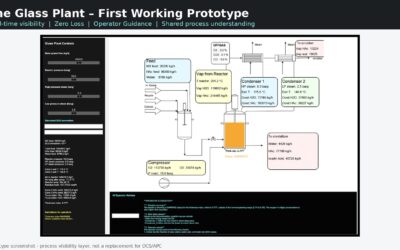
The Glass Plant – Prototype completed
The first prototype of The Glass Plant has been completed. The application has been designed to support process plants in two main ways: Offline mode For simulation, what-if analysis, operator training, and process understanding. Online mode For real-time operational...
Statistical Approach vs the Glass Plant
In chemical plant optimisation, statistics can point to hidden effects, but they do not always explain plant behaviour. This is where deeper process understanding becomes essential.
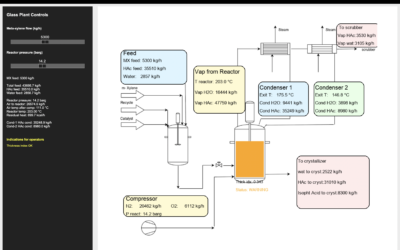
The Glass Plant: Making Plant Behaviour Visible, Shared, and Actionable
The Glass Plant is a dynamic visual representation approach that helps process plants make internal behaviour more visible, understandable, and actionable. By linking design knowledge, operating data, and process understanding, it supports operator training, knowledge transfer, performance improvement, and safer plant operation.
The user interface of the “Glass Plant” is one of the major concerns in the development of the system.
Some very strong insights come from Don Norman’s work on design, especially the idea that good design must start from an understanding of how people actually think, interpret, and act. With the rapid progression of AI, now acting as the knowledge engine behind many...
Turning Plant Complexity into Faster Decisions
Why 1+Piote In the process industries, the combination of system complexity and technical depth often creates silos: critical information does not flow smoothly between Operations, Engineering, Maintenance, Quality, and Management. Senior leadership should act...

Why We Still Sail by the Stars in Modern Chemical Plants
Chemical plant operators often “sail by the stars,” relying on isolated signals and experience to navigate complex systems.
Despite powerful control systems, the deeper structure of the plant remains invisible.
What if operators could actually see where they are going?
Why does knowledge not travel with people?
After years managing operations and technical services, a recurring pattern emerged: moving people did not move knowledge.
Some departments, however, consistently developed a better system-level view.
This reflection explores why—and what chemical plants can learn from it.
Zero Loss – Defining the Performance Baseline in Chemical Plants
Zero Loss in chemical plants starts from the theoretical material balance. Learn how defining the baseline reduces waste, costs, and variability.
Most problems in chemical plants are not caused by a lack of data. They are caused by a lack of shared understanding.
Let's continue the analysis of knowledge in a chemical plant. In a typical chemical plant, everyone is competent, and this is ensured by continuous training, assessments, on the job training, and so on. But knowledge and way to acquire it follow different path: •...
Why Chemical Plants Are Still Not Understood as Systems
From design offices to control rooms, chemical plant knowledge is distributed but rarely integrated. Horizontal and vertical barriers prevent operators, engineers, and managers from sharing a common understanding of the process. The result is a plant that is compliant, yet opaque—and difficult to optimise or safeguard as a whole.
Innovative ideas and use simple process engineering pt.1
We live in a world where decisions are pretty always taken on the base of experience. I had work many years (decades) in chemical plant , side to ide with the operators. In chemical plants the forces and inherent hazards are very, very big. When you join a company as...

The Process Engineer
The Process Engineer One of our members has been interview by the prestigious American Institute of Chemical Engineers (AIChE) You can find the ling of the interview below: https://chenected.aiche.org/2025/09/meet-process-engineer-alberto-arturo-luigi-carimati
The Glass Plant: Who we are
Who We Are The Glass Plant is the digital home of 1+Piote Pte Ltd, a consultancy company founded in Singapore in 2026. We support chemical and food SMEs in getting the best value from their existing assets by improving how their processes are understood, operated,...